
ATR builds own threat emitter for NGJ and Growler testing
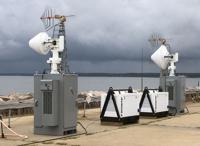
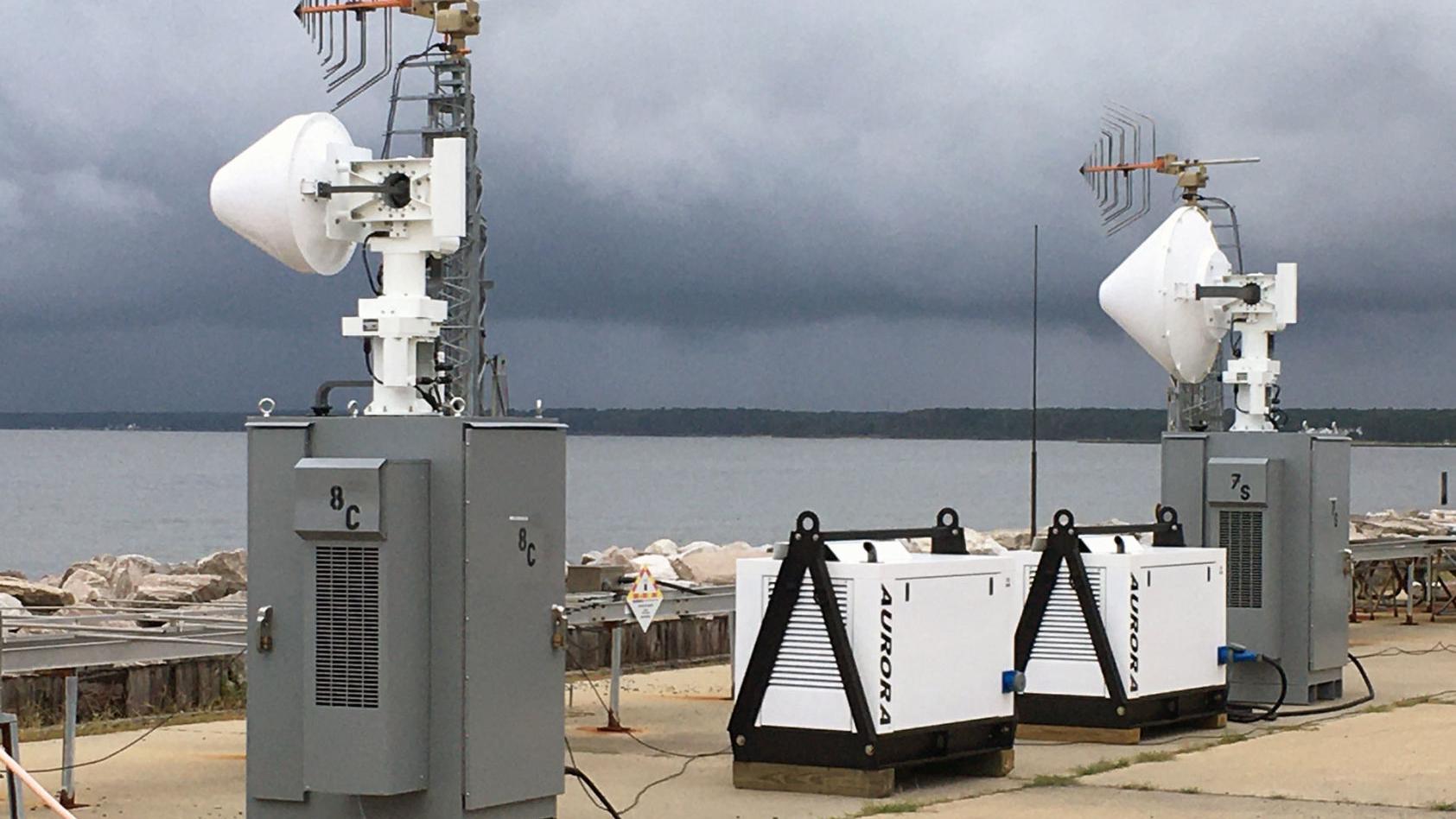
The fully functional MTES units designed for Growler and Next Generation Jammer testing have a conventional pedestal between the antenna and electronics cabinet below that rotates to vary azimuth, or horizontal direction, and tilts vertically to change elevation. Each antenna also has its own portable diesel generator (in the white box) to provide remote power.
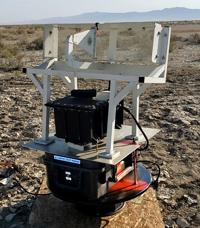

ATR tested an early prototype of the disposable MTES rotated by a pizza turntable at Dugway Proving Ground, Utah. The turntable provides an inexpensive way to vary the azimuth for target practice.
NAWCAD’s Atlantic Test Ranges (ATR) has designed and built a mobile adversary radar simulator from commercial components, primarily for testing the Navy’s EA-18G Growler and Next Generation Jammer, but with variants also available for other military weapon systems. There’s even a low-cost disposable version for Army target practice that rotates the unit with a pizza turntable.
Known as the Mobile Threat Emitter System (MTES), the new solid-state design is “unique in DoD’s test and training community,” said Jim Ashley, head of ATR’s Aircraft Signature and Avionics Measurements Branch.
Besides the Army’s request for a disposable version, he said, “the Air Force has contacted us as a result of our supporting some recent tests.”
The MTES produces radio frequency (RF) emissions that emulate real electronic warfare (EW) signals collected by allied forces around the world.
“They could be from communications systems, search radars or targeting radars,” he said. “The program gave us emitter requirements based on data collected, and our team responded. The Growler and Next Generation Jammer are tested against these requirements, and that will increase fleet lethality.”
The new MTES emitters will generate EW signals in the VHF, S, C, and X bands, according to electronics technician Steve McClead, who built the units. He said the beams emitted are much more precise with far greater range than the analog, magnetron-based legacy systems they replace.
The MTES units can be mounted on trailers or boats for downrange and offshore operations, greatly expanding the range for testing and training, said Neil Compton, ASAM/EW operations and maintenance lead. “We can take the show on the road.”
Minimizing costs was critical for the disposable Army version, Compton said. “If you’re blowing it up, you want the lowest cost possible that gets the job done.”
The team substituted a $600 commercial turntable for the expensive rotary joint that normally turns the MTES antenna, McClead said. “It’s used for either rotating pizzas or Christmas trees, depending on what web site you look at.”
To avoid complex connections in the disposable version between the rotating antenna and the stationary electronics below, the ATR team placed the entire unit on the turntable so all components rotate together.
Although the disposable versions built so far are based on legacy magnetron generators that were “collecting dust in the shop,” McClead said, the team is also building solid-state units for the Army to produce more complex waveforms.