
Advance planning key to winter preparedness aboard Pax River
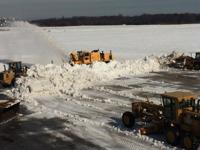
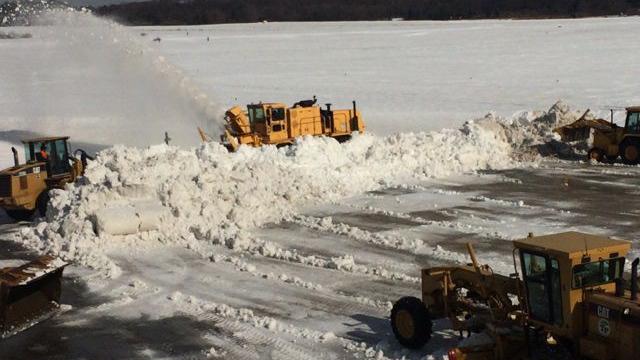
Multiple plows work to clear Trapnell Airfield after Winter Storm Jonas dropped 14 inches of snow on NAS Patuxent River in January 2016.
Winter is here and as our snowfall last month has already proven, so is the disruptive bad weather that can come along with it.
When a storm bears down on southern Maryland, it sets into motion a rippling wave of activity that spreads out across NAS Patuxent River.
Even before the snow starts to fall, personnel aboard the installation are discussing their plan of attack and as soon as the first flakes hit the ground, it’s full steam ahead.
Snow removal
“Once there’s a one-inch accumulation, it’s considered a snow event and we activate the snow removal process,” said Lt. Sonny Rowland, production officer with Public Works.
Plows will begin clearing Priority 1 areas first – main roads and essential parking – and will only initiate Priority 2 areas, such as the airfield, when it has stopped snowing and there is no more than an inch of snow left on the ground, Rowland said.
“The goal is to get as many people back to work as we can and then get the planes back in the air quickly thereafter,” he noted. “Through it all, I’ll be talking with the Public Works Officer who will be communicating with NAS Commanding Officer Capt. Scott Starkey.”
To fly or not to fly
Over on the airfield, Airfield Services Division (AFS) personnel will ensure the E-28 arresting gear is offline and begin marking strategic taxiway and runway lights to avoid plow damage, and will conduct frequent Runway Condition Reading (RCR) checks to monitor runway friction.
“When you get a ‘nil’ reading, it means an aircraft will experience little or no braking action when the pilot applies the brakes,” explained Jim Fletcher, Pax River airfield manager. “At that point, we’ll go through the Air Ops officer and he’ll brief NAS command about closing the airfield down.”
Once plowing begins out on the airfield, Fletcher noted there will already be a plan laid out as to which areas are cleared first.
“Naval Test Wing Atlantic sets the priorities based on what they need,” he said. “If VX-23 has an aircraft that needs to ‘get out on a boat,’ for example, that’ll be our priority. We’ll get the VX-23 ramp opened up, so once we start flying again, they’re the first to go.”
It usually takes about two days to get everything cleared and runways will reopen only if there’s good traction, and only after AFS personnel have conducted a complete sweep and FOD (foreign object damage) check.
“They’ll want to make sure the snow plows left no snow removal equipment parts on the airfield,” Fletcher said.
Command decision
As the NAS commanding officer, Starkey ultimately determines what course of action is taken in any emergency condition that results in changes to the installation’s normal operation; and his decision not only affects Pax River operations and personnel, but the community as well.
In addition to being briefed about the air station’s situation during bad weather, Starkey also communicates with the St. Mary’s County school district and emergency operations center.
“The decisions made are definitely not just Navy-related,” said Craig Buist, Pax River operations officer. “If 22,000 people are coming onto the base, it directly affects the county’s ability to plow. They may even ask us to delay opening for a while so they can clear Route 235 and other main arteries.”
Buist also noted that if schools are closed and the base is closed, the situation presents a childcare issue for essential personnel who must report for work.
“It affects our child care center because we have to bring in just enough people to serve our critical personnel who require child care,” he said.
Safety first
The core theme that runs throughout all of the weather preparation, discussion, planning and action is safety – especially when discussing traffic onboard Pax River.
“Safety is paramount in bad weather,” stated Lt. Robert Files, installation security officer. “Always give yourself plenty of travel time and prepare for heavy traffic. When approaching the gates, slow down and use caution.”
Drivers entering the installation should always consider the safety of gate sentries.
“Upon verification of your ID, accelerate smoothly from the stopped position and be cautious of icy roadways throughout the base,” Files said. “Accelerating too fast may cause the tires to spin and possibly send your vehicle into a fishtail –a common occurrence when the ground is wet or icy – and that could pose a danger to our gate sentries and surrounding drivers. In addition, if you see a truck plowing snow, allow them to finish their job before trying to rush past.”
Files also added that state law requires drivers to remove snow and ice from their entire vehicle, not just from a small portion of their windshield directly in front of the steering wheel. This prevents accumulated snow or ice from flying off the vehicle and causing damage to others around you.
“Keep an ice scraper handy,” he suggested. “All windows should be clear of ice and snow for maximum visibility. Drive safely and plan accordingly.”