
Walter Reed Bethesda Hosts Third Annual Lung Cancer Screening Awareness Day
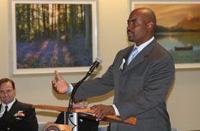
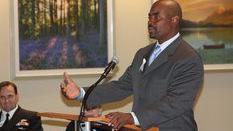
Former NFL player Chris Draft shares his personal story regarding lung cancer during the John P. Murtha Cancer Center’s Third Annual Lung Cancer Screening Awareness Day program on Nov. 5 at Walter Reed Bethesda. He lost his wife to lung cancer in December 2011, a year after she was diagnosed with the disease. She was not a smoker. “We want people to know anyone can get the disease,” Draft said.
- Credit: Photo by Bernard S. Little
The John P. Murtha Cancer Center at Walter Reed National Military Medical Center (WRNMMC) hosted its Third Annual Lung Cancer Screening Awareness Day Nov. 5.
November is Lung Cancer Awareness Month, and the Great American Smoke-Out will also be observed Nov. 20.
Navy Capt. Sarah L. Martin, WRNMMC chief of staff, said the Lung Cancer Screening Awareness Day at Walter Reed Bethesda “is truly about the beneficiaries we serve — our veterans, our active duty, their family members and our retirees. We have a significant population who are at a much higher risk [for lung cancer] than other populations.” She added the military population may be at twice the risk for developing lung cancer than other populations.
“That’s why this initiative [lung cancer screening] is extremely important,” Martin said. She added teaching prevention is important to discourage service members and others not to smoke, in addition to identifying those who are already at high risk for lung cancer.
Screening those at high risk for lung cancer using low dose computed tomography (CT) can increase survivability by 20 percent, added Lt. Cmdr. (Dr.) Corey A. Carter, hematologist and medical oncologist and internal medicine chief of thoracic oncology at WRNMMC. He explained that in honor of veterans, WRNMMC and the Murtha Cancer Center, the Department of Defense’s only Center of Excellence for Cancer Care, launched the Lung Cancer Screening Initiative in November 2012. The multidisciplinary program includes an evaluation to determine if a veteran or beneficiary is at risk for lung cancer and for those at high risk, enrollment into a screening program that will conduct annual low-dose chest CT scans and smoking cessation.
Carter said an estimated 50 percent of Vietnam veterans continue to smoke cigarettes, and their chances for lung cancer may be increased due to their possible exposure to other known carcinogens including Agent Orange, radon, asbestos, diesel fuel and other battlefield emissions.
Dr. Arthur Kellerman, dean of the F. Edward Hebert School of Medicine at the Uniformed Services University of the Health Sciences, also spoke at the event, explaining his father was a member of the “greatest generation. Twenty-five years ago, my father was diagnosed with lung cancer. And like many in the greatest generation, my father [began to] smoke when he was in the military.”
The USU medical school dean explained that he began in elementary school to discourage his father from smoking. “I won him over when I was in high school, but that was too late.” Kellerman said he knew then that he had less than nine months left with “his best friend,” his father.
“We’ve come a long way since then,” Kellerman continued. “Every one of you at Walter Reed Bethesda has made a difference by encouraging early screening [of beneficiaries], getting them in for care, providing optimum evidence-based treatment and treating every man, woman and child who you take care of like they are a member of your family. Thank you all for what you do.”
Sheila Ross, senior policy advisor of the Lung Cancer Alliance, also spoke at the event. A 14-year lung cancer survivor, Ross said it’s an honor to work with staff at WRNMMC in the battle against lung cancer.
“This is a very critical time for lung cancer,” Ross said. She explained while lung cancer remains one of the “most lethal” cancers, Walter Reed Bethesda and the Murtha Cancer Center are “playing a pivotal role in changing that fact.
“The change is early detection,” Ross continued. “Just as mammograms have done for breast cancer, and colonoscopies for colon cancer, we know now that CT scans can find lung cancer at its earliest, most treatable, even curable stage.”
Former NFL player Chris Draft also shared his personal story regarding lung cancer during the program. He lost his wife to the disease in December 2011. He explained his wife, Keasha, was not a smoker and lived a healthy lifestyle, was diagnosed with Stage IV lung cancer in December 2010 at the age of 38. He said during the year after she was diagnosed and before she passed, she valiantly battled the disease.
“We want people to know anyone can get cancer,” Draft said, adding “the ultimate goal is survivorship” and that CT screening is saving lives.
More than 400 Americans die from lung cancer every day, according to American Cancer Society (ACS) officials. Lung cancer causes more deaths than the next three most common cancers combined (colon, breast and pancreatic), and an estimated 159,260 Americans are expected to die from lung cancer in 2014, accounting for approximately 27 percent of all cancer deaths, the ACS also reports.
The Centers for Disease Control and Prevention (CDC) states lung cancer is the leading cancer killer in both men and women in the United States, and in 1987, it surpassed breast cancer to become the leading cause of cancer deaths in women.
According to the CDC, not everyone has the same symptoms for lung cancer, but some of the most common signs for the disease include:
- Shortness of breath
- Coughing that doesn’t go away
- Wheezing
- Coughing up blood
- Chest pain
- Repeated respiratory infections such as bronchitis or pneumonia
The CDC also reports people can reduce their risk of developing lung cancer in several ways, including the following:
- Don’t smoke. If you do smoke, quit now
- Avoid secondhand smoke
- Have your home tested for radon and take corrective actions if high levels are found
- Follow health and safety guidelines in the workplace when working with toxic materials.
- Avoid diesel exhaust and other harmful air pollutants.
To participate in the lung cancer screening at WRNMMC, beneficiaries can call 301-295-4191.