
WRNMMC Unveils Baby-Friendly Birth Facility Designation Plaque
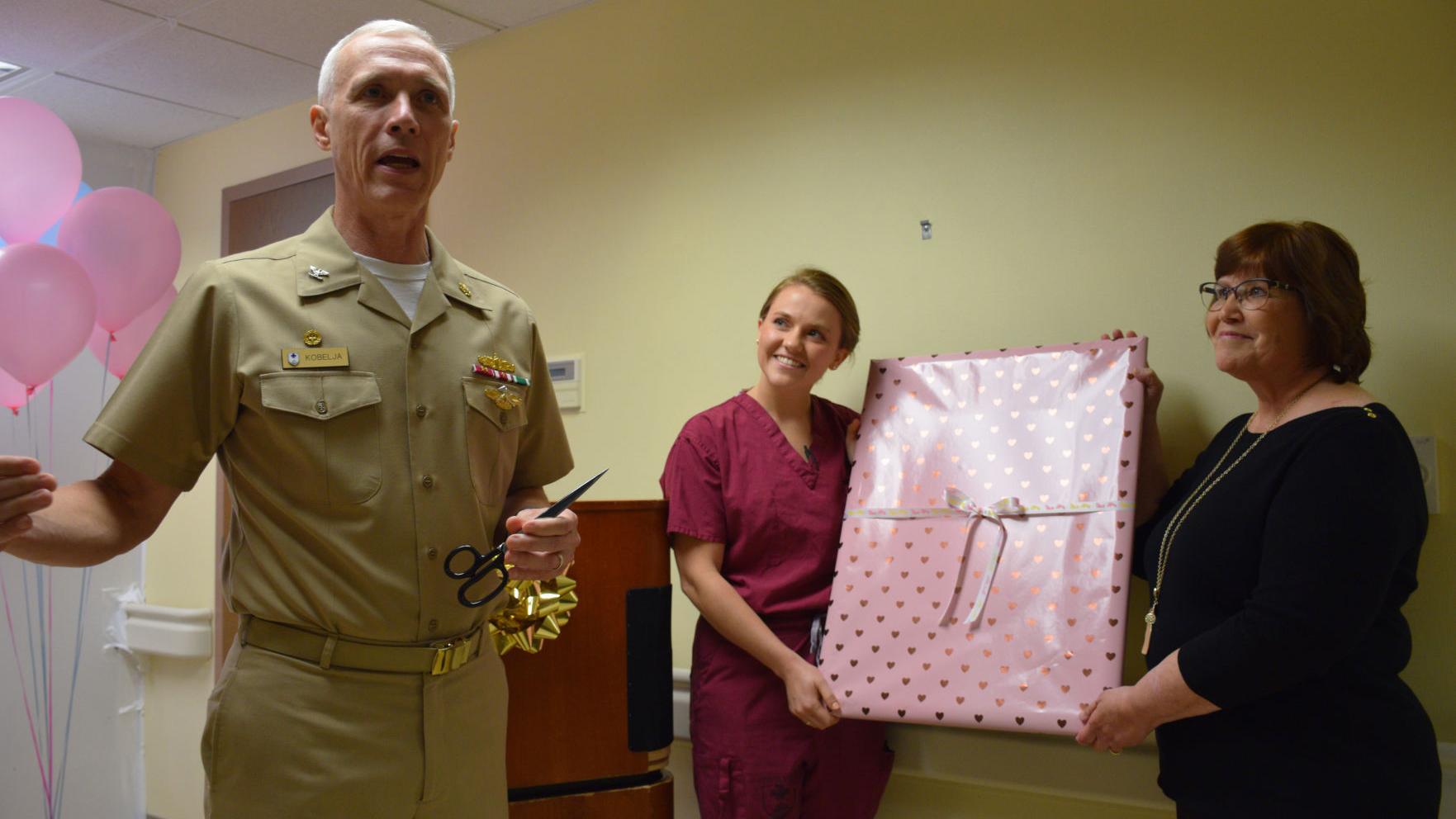
Navy Capt. (Dr.) Mark A. Kobelja, Walter Reed National Military Medical Center director, Navy Lt. j.g. Renee Redman (center), a registered nurse in WRNMMC’s Mother Infant Care Center and Leasa Freese, WRNMMC’s lead lactation consultant, prepare to unveil the plaque designating WRNMMC as a baby-friendly birth facility during a ceremony Aug. 22 in the hospital.
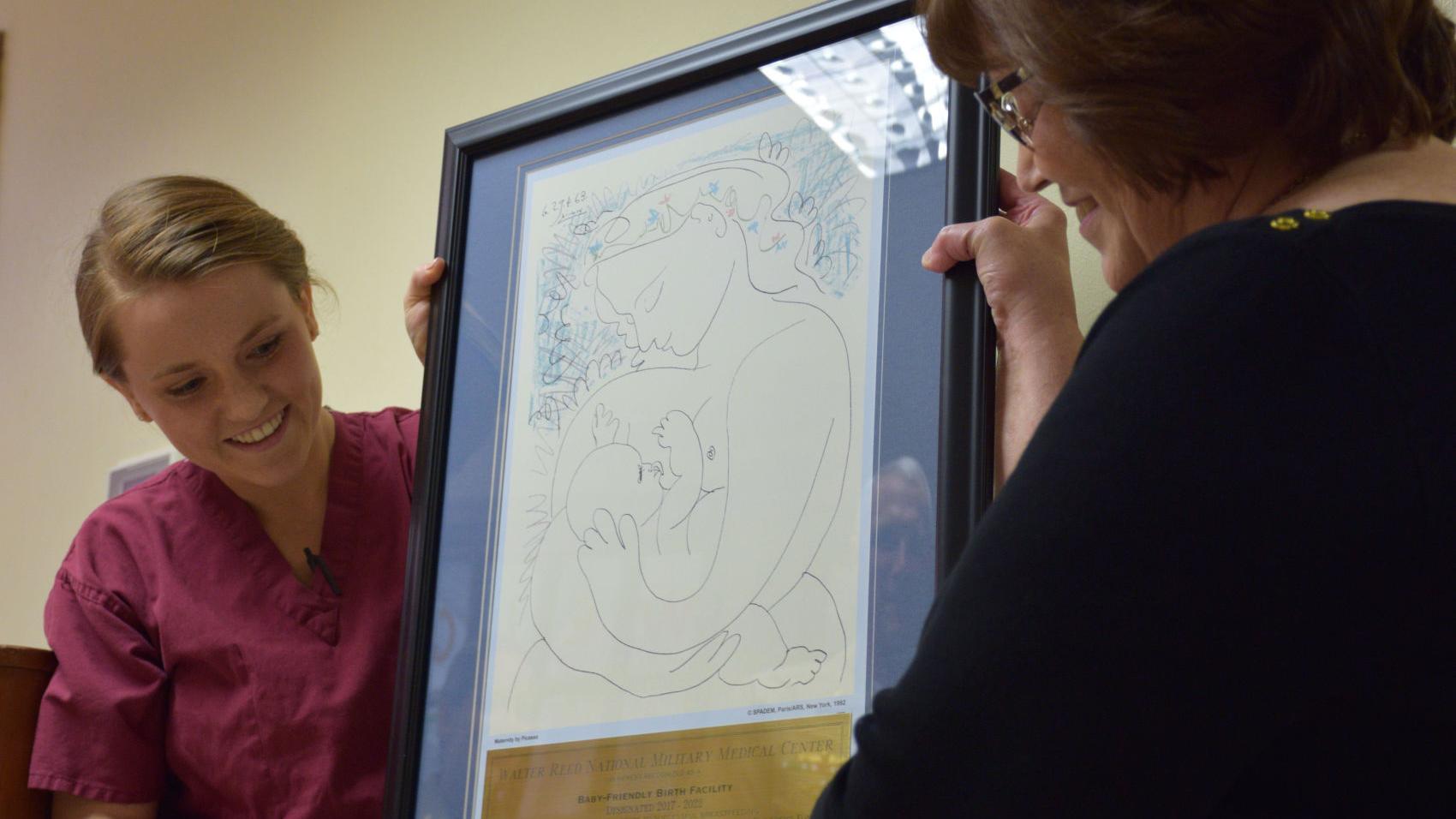
Navy Lt. j.g. Renee Redman (left) a registered nurse in Walter Reed Bethesda’s Mother Infant Care Center and Leasa Freese, Walter Reed Bethesda’s lead lactation consultant, hang the plaque designating Walter Reed National Military Medical Center as a baby-friendly birth facility during a ceremony Aug. 22.
Walter Reed Bethesda leadership and Mother Infant Care Center staff unveiled a plaque designating the medical center as a baby-friendly birth facility during a ceremony Aug. 22 in front of the MICC in the hospital.
Navy Capt. (Dr.) Mark A. Kobelja, WRNMMC director, said a focus of his is improving the high quality health care and outcomes delivered at the medical center. “It’s hard work. It requires enormous effort. Our patients assume we’re [providing high quality health care and outcomes], so they’re measuring us on their experiences of care. While we’re busy getting at that quality of health care, [our patients] are actually assessing if we are meeting their expectation of the experience of care.”
The WRNMMC director added the MICC staff is “brilliant at navigating a high volume, high risk environment” while meeting patients’ expectation of experience, which is probably the highest of any level in the hospital.
“It’s extraordinarily difficulty what you do here, and you never take anything for granted,” Kobelja continued. He said WRNMMC earning baby-friendly designation matters because evidence-based research indicates those breastfeeding initiatives emphasized by Baby Friendly USA, along with the World Health Organization and United Nations Children’s Fund, improve the quality of life for mothers and babies, as well as enhance health-care outcomes.
Seeking the designation at WRNMMC was not a “top down” directive coming from leadership, Kobelja furthered. “This was the experts coming to the administration saying, ‘We have to do this,’” he stated.
Evaluating WRNMMC for baby-friendly designation during a site visit, Baby Friendly USA assessors were impressed by the MICC team, as well as the volume of care they provide beneficiaries, said Navy Cmdr. Cathy Luna, certified nurse midwife and service chief for Advanced Practice Nurses in the Department of Obstetrics and Gynecology at the medical center.
“Our nurses and other providers work with our moms around the clock to teach them how to breastfeed and bond [with their babies]. They work with the families in the Neonatal Intensive Care Unit. The [baby-friendly birth facility] designation is a reflection of our staff and a testament to the care they provide to our Walter Reed Bethesda families,” Luna added.
“When we first moved up here [prior to 2012], we were a family-friendly unit,” said retired Navy Capt. (Dr.) Jeffrey Greenwald, a neonatologist in Newborn Medicine, Department of Pediatrics at WRNMMC. “We’ve always been baby-friendly, and now we have a nice plaque [indicating so],” he added.
“Our staff supports new mothers regardless of their baby-feeding methods,” said Leasa Freese, WRNMMC’s lead lactation consultant. “Practicing rooming-in, allowing mothers and infants to remain together 24-hours a day, is something we encourage,” she furthered.
Freese praised all members of the MICC, NICU and Logistics teams for playing a part in the medical center earning the baby-friendly birth facility designation. “I only train [the nurses and providers]; they are the ones who did the work to make this happen,” she added.
Walter Reed Bethesda began seeking the baby-friendly designation in 2012 following the merger of Walter Reed Army Medical Center and the National Naval Medical Center in the summer of 2011. The process for earning the designation requires extensive training and review of a facility’s staff.
Prior to the merger of WRAMC and NNMC, neither facility had the baby-friendly designation, although NNMC’s labor and delivery unit focused extensively on care of mothers with higher-risk pregnancies. WRAMC stopped baby deliveries in the 1990s and referred obstetrics and gynecology beneficiaries to either NNMC or Fort Belvoir Community Hospital (Va.).
In order to be designated as a baby-friendly facility, WRNMMC had to complete all four phases of the 4-D Pathway to baby-friendly designation, established by the accrediting body for the baby-friendly hospital initiative. Phases of the pathway include discovery (completion of a self-appraisal tool), development (establishing a baby-friendly committee/task force, BFHI work plan, hospital breastfeeding policy, staff training plan, prenatal/postpartum teaching plans, data collection plan), dissemination (staff training and data collection) and designation (implementing quality improvement plan, readiness interview and on-site assessment).
WRNMMC also had to successfully implement and execute the Ten Steps to Successful Breastfeeding for the baby-friendly designation. The steps include the following: having written breastfeeding policy that is routinely communicated to all health-care staff; training all health-care staff in skills necessary to implement the policy; informing all pregnant women about the benefits and management of breastfeeding; helping mothers initiate breastfeeding within one hour of birth; showing mothers how to breastfeed and how to maintain lactation; giving infants no food or drink other than breast-milk, unless medically indicated; practicing rooming in (allowing mothers and infants to remain together 24 hours a day); encouraging breastfeeding on demand; giving no pacifiers or artificial nipples to breastfeeding infants; and fostering the establishment of breastfeeding support groups and referring mothers to them on discharge from the hospital or birth center.
According to the preamble to the U.S. Baby-Friendly Guidelines and Criteria, “evaluations have found that breastfeeding is the single most powerful and well-documented preventative modality available to health-care providers to reduce the risk of common causes of infant morbidity.”
The preamble also includes studies that have shown there are significantly lower rates of diarrhea, otitis media, lower respiratory tract infections, Type 1 and Type 2 diabetes, childhood leukemia, necrotizing enterocolitis, and Sudden Infant Death Syndrome in infants who are breastfed. Additionally, women who breastfeed have a lower risk of Type 2 diabetes and breast and ovarian cancers.