
SAR crew joins rescue efforts in Chesapeake Bay emergency
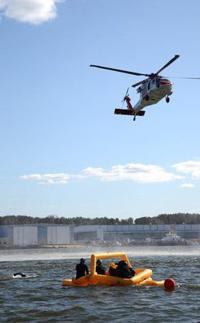
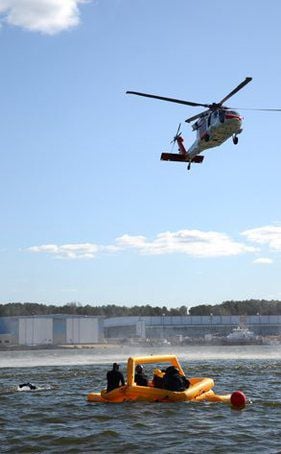
Search and Rescue crews practice water recovery near the East Basin, skills they used during a mutual aid rescue April 20. - Credit: U.S. Navy photo by Kelly Schindler
PATUXENT RIVER, Md. -- It was a brisk, windy Saturday morning as anglers, including a group of six trying their luck in a 25-foot fishing boat, headed out on the Chesapeake Bay for opening day of rockfish season.
Battling waves of 3-5 feet, 2 miles from Point Lookout State Park on April 20, the boat’s owner/operator made a phone call for help as the vessel began to take on water. At 8:30 a.m., not too long after that emergency call, communications with the vessel were lost — the boat had capsized.
Hearing the chatter over the maritime radio, Pax’s Search and Rescue (SAR) crew were at the ready.
“The nearest units capable of airborne water rescue are the Coast Guard units in Atlantic City [N.J.] and Elizabeth City [N.C.],” said Lt. Cmdr. Gregory Rowland, an NAS Patuxent River SAR pilot. “But that’s pretty far off. We’re the only ones with that capability in this area because we can handle the medical issues and have rescue swimmers who can come to the aid of persons in the water.”
On that day, the four-person SAR water rescue crew included: pilot Rowland, with 14 years experience; copilot Lt. Daniel Lefler, with 14 years experience; crew chief Naval Aircrewman (Helicopter) 1st Class John McCracken, with eight years experience, and the swimmer, Naval Aircrewman (Helicopter) 3rd Class Tanner Williams, with three years experience.
Expediting their preflight checks, Lefler said Pax’s SAR crew were quick to join in the rescue efforts of Coast Guard St. Inigoes, the Maryland Natural Resources Police, Maryland State Police Trooper 7 helicopter, and the Ridge and Valley Lee volunteer fire companies.
It took the crew just 7 minutes from Pax to arrive on scene where they immediately saw the overturned boat among the floating debris. As they hovered to assess the situation, they decided to back off a bit to not impede the rescue operations below.
The crew said they began surveying the scene’s surrounding waters, taking into consideration how winds and currents were shifting the wreckage and its items below.
The crew focused in on some floating gear they noticed near the rescue boats earlier that had been carried off by the current. Hovering 70 feet over the gear, they decided to lower Williams, the rescue swimmer, to investigate.
Donned in a dry suit with a thermal layer underneath, Williams dove into the 50-degree water.
“I didn’t see anyone when I got in the water; just debris,” he said. “Then, I saw a nautical ladder with a life jacket wrapped around it.”
But, after swimming to the ladder and inspecting the area around it, Williams found nothing.
“Then, I looked underwater,” he said, “and there were rope lines descending down, but nothing attached them.”
With his underwater visibility limited to just a foot, Williams began pulling the lines up.
“One of [the lines] was actually attached to the victim’s ankle,” he said. “As I started pulling, he started to come up with it.”
Then, it was a matter of untangling the victim, getting him in the basket and up to the helicopter.
“When you’re looking for someone out at sea, you know they’re going to be in some state of shock, but not to that extent,” McCracken said about the limp body they pulled from the water.
With Rowland and Lefler at the stick, McCracken and Williams were in the back providing emergency medical care trying to revive the victim during the 15-minute flight to St. Mary’s hospital.
“You just have to do what you’re trained to do,” McCracken said.
Having the nearly year-long technical training school under their belt and continual training with hospital corpsmen on station, McCracken and Williams are skilled in performing basic life-saving techniques, such as CPR, splinting, tourniquets and making head-to-toe medical assessments. But, none of the crew had ever experienced a rescue such as this.
“We’ve done medivacs, but never an over water rescue,” McCracken and the crew agreed.
According to Coast Guard St. Inigoes, the six on the capsized vessel were a couple, their teenage son and three friends, and not everyone wore a life vest.
“Just like a seat belt, people think it’s not cool so they don’t wear it,” Rowland said about life vests. “All it takes is one time.”
Officials are investigating the cause of the accident. Out of the six pulled from the water that day, two died.