





Strolling the river walk along the Washington Navy Yard waterfront today, it is hard to imagine that the Anacostia River, from the Yard all the way to its confluence with the Potomac River, was a testing area for the weapons being built here before and during the Civil War. Or that the Yard was once home to more than 20,000 workers in its weapons manufacturing facilities from World War II until the 1960s.
Harder still is picturing what the area surrounding the Navy Yard would have looked like when President George Washington picked the site of what would become the U.S. Navy’s largest shipbuilding and ship refitting facility in 1799, creating the Navy’s oldest active shore base.
Who knew – except for the dedicated Navy personnel and civilians who work there – the history that was hiding behind the impressive white façade of the Latrobe Gate on the Navy Yard’s M Street boundary? But thanks to Kristina Higgins, Command Public Affairs Officer for the Naval History and Heritage Command and NHHC Education Specialist Michael Galloway, At Ease was provided a behind-the-gate glimpse into the legends and legacy of this important Navy installation.

The Washington Navy Yard's Latrobe Gate on M Street.
According to Galloway, the Navy Yard was created in 1799 for the purpose of having a government-run shipbuilding activity. The Yard was supposed to build large ships of the line – a 50 or more-gun vessel – but that didn’t happen, he noted, due to the shallow depth of the East Branch of the Potomac (Anacostia River) caused by its shifting sandy bottom.
“Shipping vessels already had a presence in that area in the 1700s along with many docks,” Galloway explained. “The area had plenty of trees to supply lumber for ship building and the marshes supplied hemp for making rope. I found a map in the Library of Congress from 1792 that shows the area was pretty much entirely farmland with heavy woodland. In the book “Round Shot to Rockets”, one of the histories of the Navy Yard, it talks about Commandant of the Navy Yard Thomas Tingey’s first arrival here in January 1800, and he describes it as a wilderness.”
During its early years, the Navy Yard became the Navy’s largest shipbuilding and ship-refitting facility. The History and Heritage Command notes that 22 vessels were built at the Yard, from 70-foot gun boats to the Minnesota, a 246-foot steam frigate. In 1815, Navy leaders decided to limit the role of the Yard to just shipbuilding, eventually leading to the Yard’s shift in focus to ordnance and technology for the next century. By the 1850s, the Yard's primary function had evolved into ordnance production, spurred by the engineering genius Lieutenant John Dahlgren (who would also serve as the commandant of the Yard).
“Early Navy Yards did a little bit of everything and that comes down to infrastructure,” Galloway shared. “There weren’t good roads in early America and there weren’t railroads until the 1830s, so you had to do everything in one spot. By the mid-1800’s the Navy starts to separate operations, so with John Dahlgren, the Father of Naval Ordnance, already establishing a lot of great gunnery work here with testing and development, that’s when the Washington Navy Yard becomes a Naval gun factory, and then the Yard is named the U.S. Naval Gun Factory (in World War ll). And that was the Yard’s purpose until the 1960s.”
Galloway admitted that many people are surprised to learn about the Navy Yard’s history of shipbuilding and ordnance manufacturing. At the Yard’s height of production, some 25,000 people were working at the Navy Yard, becoming one of the largest employers for the local community, he said. He added that in the 19th century a lot of homes were built for workers just north of the Yard and that worker neighborhoods also formed on the east and southeast sides of the Yard starting in the early 1900s.
“When you are in Washington, D.C., what do you think about – The Pentagon, the Capital and the city being a hub for government and policy,” Galloway said. “You don’t think about this being a get-your-hands-dirty, blue-collar town. The Navy Yard may be one of the larger remnants of manufacturing that took place in this area. There were 188 buildings, on 26 acres making some of the most dangerous and advanced weapons materials in the world by the end of World War II.”

This 1947 photos shows what was called the Navy Gun Factory.
Higgins noted that visitors to the Yard are also amazed by the Optical Tower, a reminder of the Yard’s scientific and manufacturing history.
“Just the practicality of putting the tower in the middle of D.C. and using the monuments and buildings of the city to calibrate weapon sights that were manufactured here,” she explained.
From the tower, which was built in 1918, sightings were taken on the United States Capitol, the Washington Monument and the Masonic Temple in Alexandria, 10 miles away.
Galloway added that the Anacostia River really was a testing area for the weapons being built at the Yard until the creation of longer-range guns. He said that the Naval test batteries were a big deal for the local community. People would come out to the riverbanks with picnics and watch the guns fire, staying safely out of range.
“President Abraham Lincoln was a frequent visitor to the Navy Yard during the Civil War, and loved to talk with Dahlgren about weapon development,” Galloway shared. “In a tragic twist, his assassins are also associated with the Yard. John Wilkes Booth escaped across the early Navy Yard Bridge, and his body was brought to the USS Montauk at the Navy Yard for a postmortem examination. Some of his co-conspirators were held in the copper rolling building before their trial at Fort McNair.”
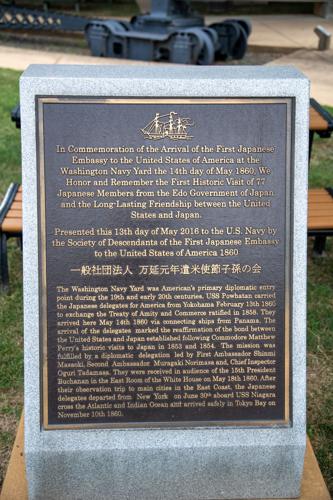
The Yard also was the arrival point in D.C. for many distinguished visitors through the early history of the nation. As Galloway explained, “Before transatlantic flights become routine – where are you going to have visiting dignitaries arrive? They would land by boat at the Navy Yard, including Japan’s first embassy personnel in 1860.”

Another famous moment for the Navy Yard was the arrival of the USS Olympia, carrying the remains of the United States’ World War I Unknown Soldier, docking at the Yard on Nov. 9, 1921, he noted.

The casket of the World War l Unknown Soldier is escorted from the USS Olympia at the Navy Yard, November 1921.
As the U.S. Navy marks its 250th birthday on Oct. 13, the Navy’s oldest shore establishment still has a critical role to play for the force, Higgins explained.
“While its history is unparalleled, the Yard’s modern strategic importance stems directly from the concentration of vital commands headquartered on its grounds: the Chief of Naval Operations, Naval Sea Systems Command (NAVSEA), Navy Installations Command (CNIC), Naval History and Heritage Command (NHHC), Naval Facilities Engineering Systems Command (NAVFAC), and Strategic Systems Programs (SSP). The Yard is the administrative and operational heart of the fleet,” she said.
Looking into the future, the Navy Yard will also be a part of the continuing beautification and development of the surrounding community, Higgins added.
“One of the things we are really excited about at Naval History and Heritage Command is that the Navy Yard is going to be a part of that growth through the construction of the new National Museum of the U.S. Navy,” she said. “The museum is going to be built in an unused field just off the Navy Yard. I don’t know if that would have been possible if not for the expansion of the Nat’s Park and the Navy Yard area over the last 20 years. The Navy wanted to keep the museum in D.C.; they wanted it to be walkable, have Metro access and the current growth of the local area made it an easy choice to put the new museum next to the Navy Yard.”

Though the current museum is closed, it still hosts special events, including for the Navy’s 250th anniversary. Galloway said that interested individuals can visit the 250th events tab on the Museum’s website — www.history.navy.mil/content/history/museums/nmusn/navy250.html — to see all the planned activities, locally and at other Navy installations near Washington.
The above URL may not display correctly for all users.
Excitement is building as the Navy moves closer to groundbreaking for the new National Museu…