
Pax Sailors Join Auxiliary Security Force
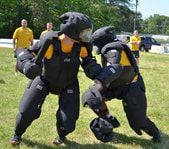
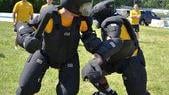
From left, Hospital Corpsman 2nd Class Casey Susany and Hospitalman Gregory Tate practice hand-to-hand martial arts techniques during Auxiliary Security Force training at Naval Air Station Patuxent River on June 20.
- Credit: U.S. Navy photo by PS2 Jheyson Giraldo
Twenty-three volunteer Sailors from tenant commands across Naval Air Station Patuxent River joined the ranks of the installation’s Auxiliary Security Force after certification and graduation June 25 from a 12-day training program.
ASF are E-6 and below service members provided by tenant commands according to their military populations, and are used to augment Pax River’s security force.
“They are trained in basic force protection and guard duties such as entry control and mission essential asset protection,” said Lt. Troy Niccum, Pax River security officer. “They do not perform law enforcement functions.”
Police Sgt. James Williams, the security training officer who led the program, also explained that ASF can be called upon by the base commanding officer whenever extra security is needed — during times of increased force protection conditions, anti-terrorism measures or when large crowds visit the base for public events.
“While their primary function is ID check and access control at the gates, they can be utilized to protect buildings, personnel or the waterfront at the CO’s discretion,” Williams said.
The ASF program combined classroom and physical training, provided exposure to lethal and nonlethal weapons, and taught mechanical advantage control hold (MACH) techniques that use a subject’s own body momentum to enable submission.
“I’d done knee strikes before with the Marines,” said Hospital Corpsman 3rd Class Steve Fugate, “but the MACH maneuvers were new things for me. I learned a lot.”
Personnel Specialist 2nd Class Jheyson Giraldo from the Naval Health Clinic Patuxent River agreed.
“I learned how to fight better without hurting people; how to subdue without injuring,” he said. “This was a new experience and I’m excited to be part of it.”
Another day involved the class being subjected to a pepper spray exercise where each participant was sprayed across the eyebrows and forehead. Next, they had to open their eyes and count the number of fingers being held up by instructors.
“They wanted to make sure it went into our eyes and it was the worst feeling ever,” said Hospital Corpsman 2nd Class Casey Susany. “It not only burned my eyes, it also burned my skin. My eyes wanted to clench shut. I wanted to quit, but I mustered it up.”
The exercise was meant to simulate a real-world scenario where, if it was necessary to use pepper spray and self-contamination occurred, the participants would know what to expect while still attempting to subdue a perpetrator, Williams explained.
“It teaches us what we need to do under those circumstances,” Susany said. “Are we controlled? Are we still using voice commands and going through the proper procedures?”
After the punishing exercise, Sgt. Williams gave the class its due.
“They’re a class of fighters,” he said. “They maintained their control, focused on the threat, attacked the threat and achieved submission by handcuffing the threat.”
The new ASF graduates will be required to stand two 12-hour shifts per month in order to maintain their proficiency and receive sustainment training.