
Rehabilitated Raptors Visit Wounded Warriors
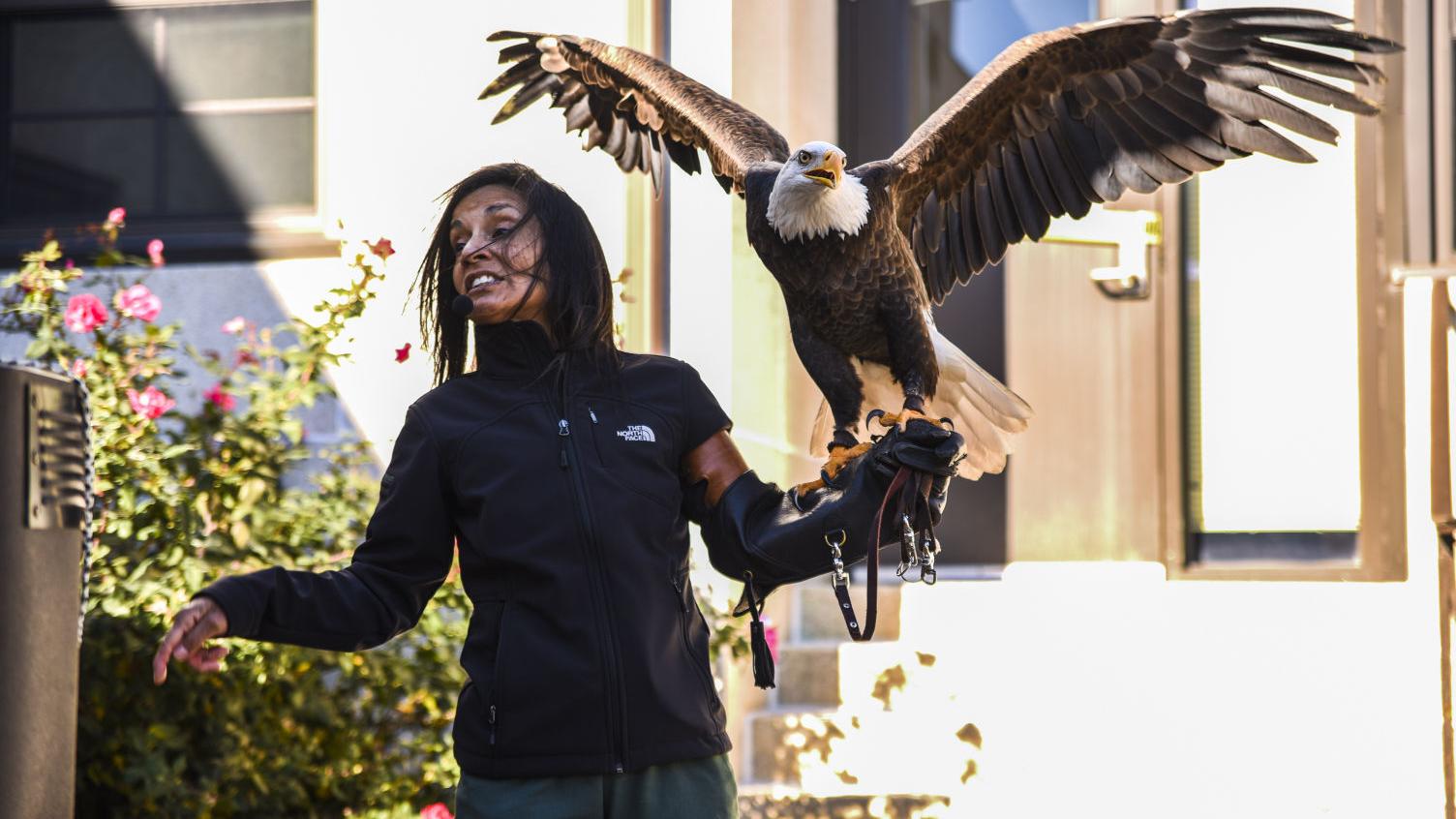
“My birds are warrior birds – eagles, falcons, kites – and all those birds, they’re warrior birds and my birds are all wounded, that’s why I have them,” said Jo Santiago, a wildlife biologist and raptor rehabilitation specialist with the U.S. Forest Service’s international program during a presentation at Naval Support Activity Bethesda Nov. 13.
One bird was wounded by a Doberman pinscher after falling out of a nest, while the other birds of prey that recently came to Naval Support Activity Bethesda (NSAB) received their injuries after getting struck by vehicles when hunting along a roadside.
“My birds are warrior birds – eagles, falcons, kites – and all those birds, they’re warrior birds and my birds are all wounded, that’s why I have them,” said Jo Santiago, a wildlife biologist and raptor rehabilitation specialist with the U.S. Forest Service’s international program.
She recently started taking her rehabilitated birds to Department of Veterans Affairs’ hospitals and Friday’s visit to NSAB was her first to an active-duty installation. She said the purpose of her visit with the birds was to bring a message of hope to wounded service members and their families.
“You can overcome anything,” Santiago said. “There’s power within you that’s untapped. If these birds can overcome obstacles and injuries, what can we do as people?”
Freedom, a 16-year-old bald eagle, had his tail feathers ripped out by a Doberman pinscher when he was young. That attack damaged his feather follicles, Santiago said, which made it so Freedom couldn’t grow in healthy tail feathers. That has affected his ability to stop and steer while flying, she said.
Freedom’s been used by the American Eagle Foundation since his injury as an education bird and is trained to fly over audiences. So, after Santiago started visiting veterans and wounded service members, she asked the foundation whether they had a bald eagle she could use in her presentations.
“I had to get a bald eagle to bring to them as a small way to honor them,” Santiago said.
Another bird Santiago showed the audience on the patio by Building 11 was Ty – a red-tailed hawk. Ty was struck by a car while hunting along a roadside and one of his wings became paralyzed for life.
“Although Ty cannot fly, he’s not helpless,” she said.
One example, she said, was when they were hanging out on a soccer field before a presentation, and the untethered Ty took off running because he wanted to get up higher.
“I took off running after him,” she said. “So, I’m running after him, and I caught him before he got to the tree line and he could’ve easily jumped to the top of the tallest tree. Because he can jump seven feet on a horizontal … and on a vertical he can go 39 inches straight up.
“So he’s not helpless by any means, he doesn’t let that wing slow him down one bit,” she said.
Santiago has been working with birds of prey for the past 26 years and Ty has been with her for the past 19 years, going with her to various demonstrations. At Friday’s demonstration, Santiago said she could tell by signs he was giving her that he was ready to go back home to West Virginia after their week of visiting various places.
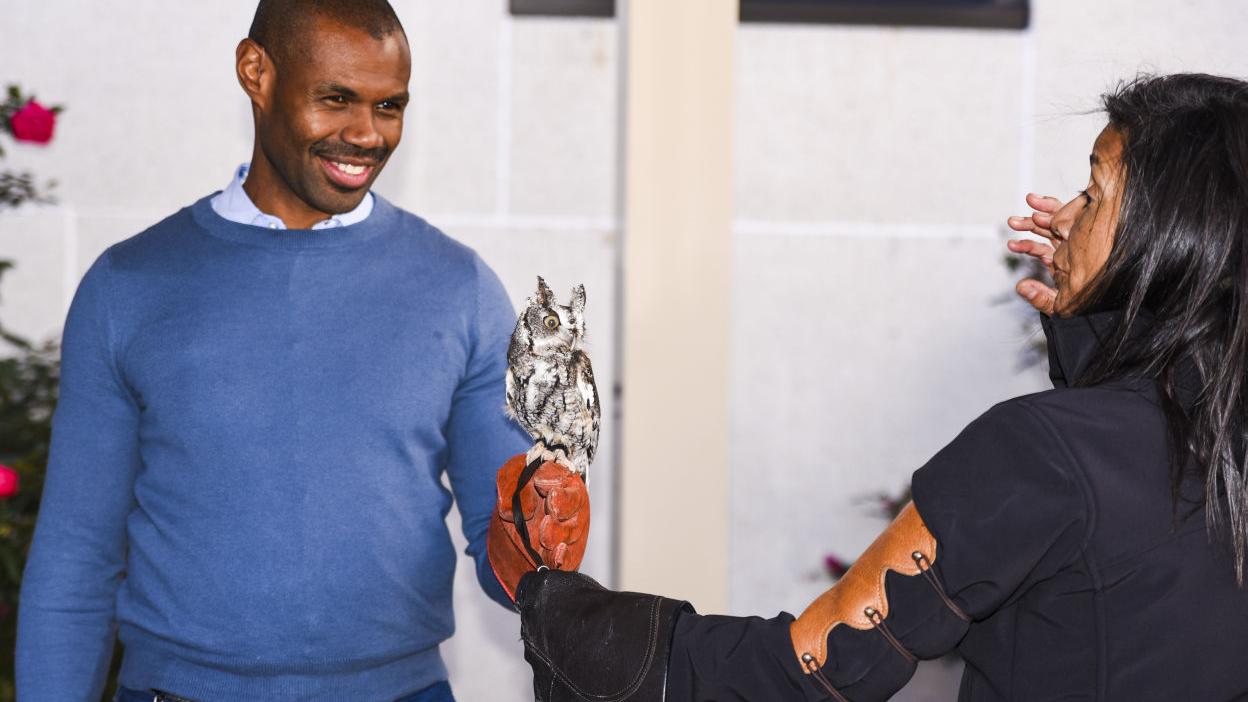
She also brought Doc, a broad-winged hawk, who suffered a concussion after getting hit by a car, as well as Obadiah, an Eastern screech owl, who became blind in one eye after a vehicle accident.
“The next bird is the original F16,” Santiago said. “What’s the F16? Anybody?”
“Falcon,” an audience member responded.
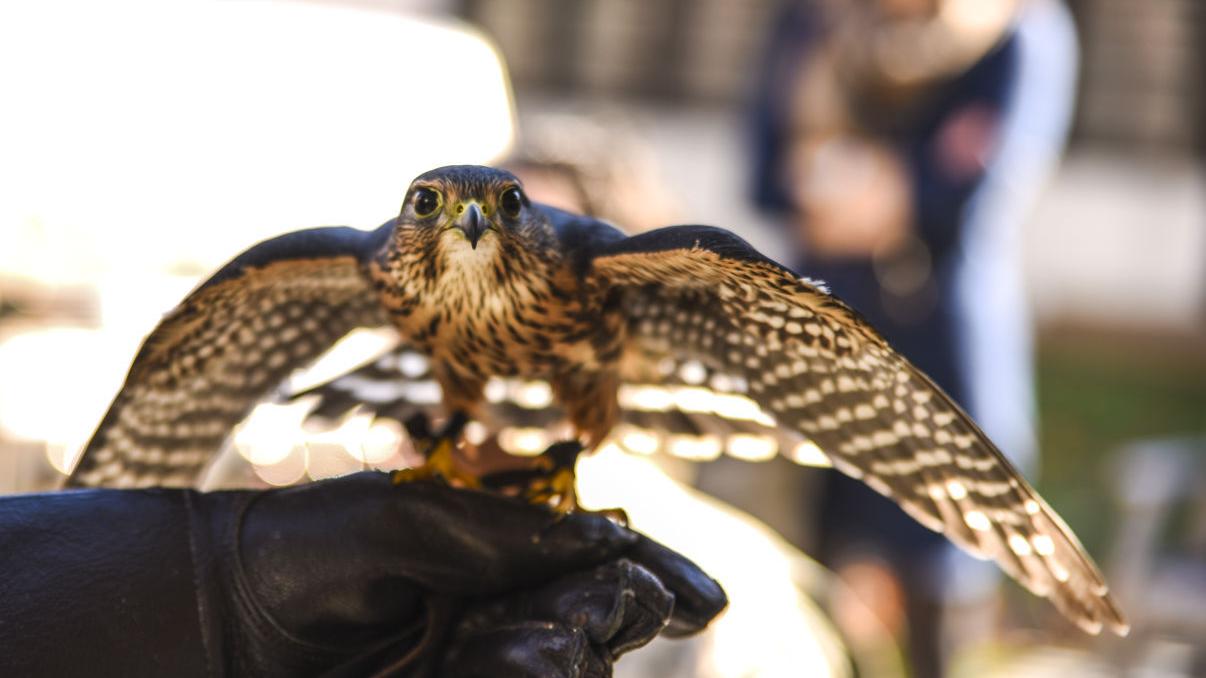
“Bingo. A fighting falcon,” Santiago said, while holding Zacchaeus, a merlin falcon who got a dislocated elbow after a getting struck by a vehicle
.
She said merlins are tenacious hunters and hone in on their prey like a missile; and are hardly ever seen by humans.
“It is so rare to see a merlin,” she said. “Most people never ever, ever get a chance to see a merlin. Although you don’t realize it, it’s something really special for you to see.”
After educating the audience about the birds, Santiago invited interested parties to come up and hold Obadiah under her supervision.
“I have to wake him up, because this is the time he’s asleep,” she said.
The Eastern screech owl is a bird that is common to the area, and Santiago said “you’ve probably all passed by one roosted up in a tree, you’ve probably passed within feet. I’m sure they’re right here on base, you just didn’t know it was there because they are so good at camouflage.”
Santiago said she enjoyed her first visit to the base and hopes to bring her rehabilitated birds back.