Search
Filter Search
-
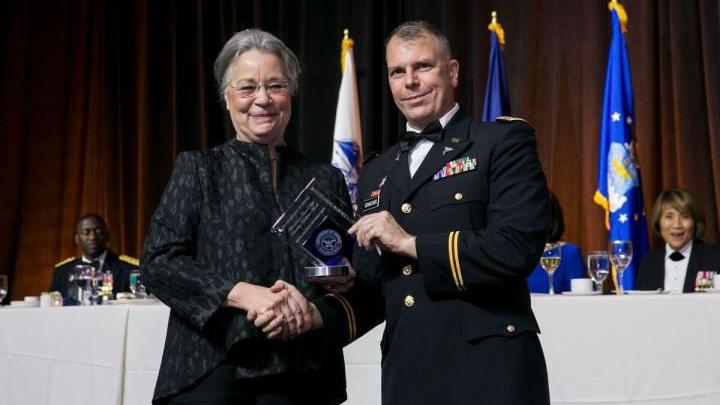
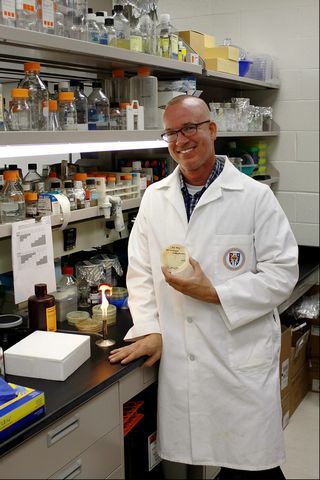
Walter Reed Officer Recognized For Work On Antibiotic-Resistant BacteriaFeaturesAntibiotics are important to the care of service members, especially those returning from the battlefield. But the rise in antibiotic-resistant bacteria concerns Military Health System (MHS) officials who are closely monitoring the rising trend and working to combat it.
By U.S. Military Health System Communications Office
1 Min Read
-
Bioretention areas offer more than green scenery on JBM-HHLocalDriving around JBM-HH, you may have noticed gardens planted in depressions and medians. These are examples of bioretention areas, where stormwater runoff flows and slowly settles into the ground instead of being carried directly to stormwater sewers. Stormwater in sewers flows directly to streams and rivers without filters or treatment. As a result, pollutants in the stormwater, including nutrients, chemicals, sediment, bacteria and trash, also end up in our local streams and rivers and ultimately affect water quality in the Chesapeake Bay. Bioretention areas are specially-designed basins that use plants and soil to filter and absorb stormwater. As it flows into the bioretention area, stormwater runoff is slowed down and drained through a filter bed containing layers of mulch, sand, soil, or other media that is planted with plants and shrubs. Pollutants are left behind or absorbed by plants, and the filtered stormwater then drains to groundwater or flows to the stormwater sewer system.
By Tiffany Lee, Environmental Management Division, JBM-HH Directorate of Public Works
2 Min Read
-
Military Researchers Fight the ‘Invisible Enemy’ of Infectious DiseasesArchiveNo one likes to talk about diarrhea, but it became a part of the conversation at the 2014 Military Health System Research Symposium in Fort Lauderdale, Florida, Aug. 20. Infectious diseases experts discussed diseases, including gastrointestinal and other infections, that service members face as they deploy around the world.
Ellen Crown
USAMRMC Public Affairs
2 Min Read
-
Flesh-eat bacteria: The facts about the contaminant found in the Chesapeake BayRegional NewsBy Connie Hempel
1 Min Read
-
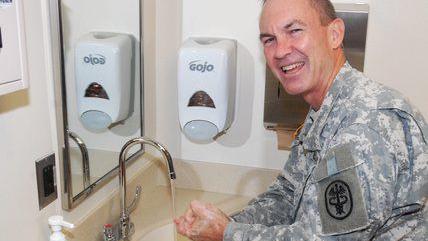
Follow the Leader: Wash Your Hands!Features“The point is not to do remarkable things, but to do the ordinary with the conviction of its immense importance,” Walter Reed Bethesda Director Army Col. (Dr.) Jeffrey B. Clark, a family medicine physician said, quoting Teilhard de Chardin, a French philosopher and Jesuit priest, while reminding staff of the importance of hand washing.
By Sharon Renee Taylor WRNMMC Public Affairs staff writer
2 Min Read
-
Army Medicine Continues its Wartime AdvancesFeaturesLast month, the military medical community was notified that a new antibiotic drug is now available to treat Soldiers who have life-threatening, multidrug resistant bacterial infections.
By David Vergun
7 Min Read
-
Worlds toughest microbe helps USU scientistsArchiveScientists at the Uniformed Services University of the Health Sciences (USU) have discovered a new way to render a microbe non-infectious while preserving its immune system-boosting properties after exposure to gamma radiation.
By Helen Hocknell, NSAB Public Affairs staff writer
2 Min Read
-
World's toughest microbe helps USU scientistsFeaturesScientists at the Uniformed Services University of the Health Sciences (USU) have discovered a new way to render a microbe non-infectious while preserving its immune system-boosting properties after exposure to gamma radiation.
By Helen Hocknell NSAB Public Affairs staff writer
2 Min Read